
Paul Borrossi - No. 340 Squadron. The Fondation de la France Libre records his final patrol leaving Perranporth on 29 February 1944. His Spitfire IX, MJ853, struck the sea during low-level flying. He was 23; his body was not recovered. [14]
TREVELLAS, CORNWALL
Perranporth Airfield
A century of aviation
1924-2026
From Spitfires and wartime service to civilian flying and a new generation of visitors.
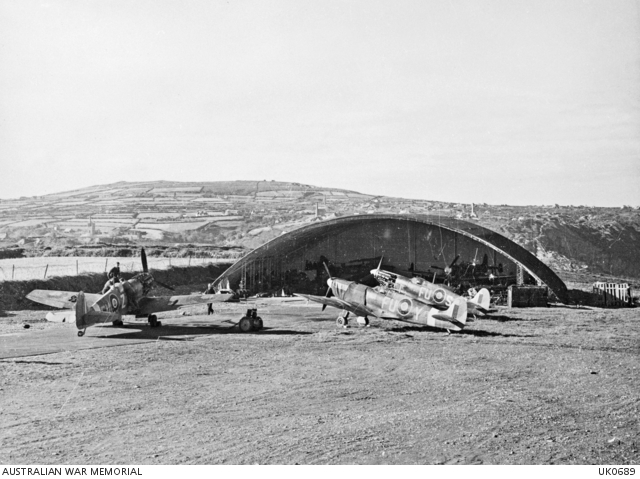
Cover: No. 453 Squadron dispersal, October 1943. Australian War Memorial, UK0689. Public domain.
ABOUT THIS EDITION
One place, many stories
At Trevellas, the history of aviation is still visible on the ground. An aircraft dispersal, a shelter or a stretch of perimeter track can connect today’s visitor with the people who worked here during the Second World War.
This booklet brings together published historical research, archival photograph descriptions, company records and the modern airfield story supplied by Andy Whitaker. The wartime and civilian narratives are followed by a working squadron directory and a remembrance section.
Inside: timeline (3); early flying and construction (4-6); Allied crews (7-10); naval service and closure (11-12); surviving structures (13); civilian development (14-16); unit directory (17-18); remembrance (19); sources (20-21).
AT A GLANCE
A century in milestones
| Date | Milestone |
|---|---|
| 1924 | Passenger pleasure flights reported at Cligga Head. [3] |
| 1940 | Military development begins. [2, 3] |
| 28 Apr 1941 | RAF Perranporth opens as Portreath’s satellite. [1] |
| 1942-1943 | Spitfire operations expand; Allied squadrons rotate through. [4] |
| Apr 1944 | Fleet Air Arm squadrons arrive. [1, 4] |
| 1945-1946 | Operational rundown and removal of many buildings. [2] |
| 1950-1951 | Brief period of civilian airline services. [6] |
| 1957 | Cornish Gliding Club begins using Perranporth. [6] |
| 2007 | John George purchases the airfield. [7, 8] |
| 2026 | Flying, driver experiences, camping and events. [9, 10] |
1924 | BEFORE THE RAF
Flights above the cliffs
The airfield’s own archived history places the beginnings of flying here in March 1924. It records Captain J. V. Holmes operating an Avro 504K, a surplus First World War training aircraft, carrying residents and holidaymakers on pleasure flights. [3]
That is a very different beginning from the later fighter station: people taking their first look at Cornwall from the air, rather than crews preparing for war.
There is scope to enrich this early chapter with local newspaper advertisements, photographs and records identifying the aircraft. Until those are located, the named pilot and aircraft should remain attributed to the archived airfield account.
1940-1941 | CONSTRUCTION
A station takes shape
After the fall of France in 1940, German aircraft could operate from bases across the Channel. Britain’s south-western ports, shipping and coastal approaches required protection. Perranporth was part of the response to that threat. [1, 3]
Construction began in 1940. In April 1941, only one runway and limited facilities were ready; the runway layout was completed by November, with further buildings and dispersals added afterwards. The station continued to evolve rather than appearing fully formed on opening day. [2]
The military airfield was designed around three intersecting hard runways, linked by a perimeter track. Aircraft could be distributed around the site instead of parked together in a single vulnerable group. [1]
1941 | OPENING
The first Spitfires
RAF Perranporth officially opened on 28 April 1941 as a satellite of RAF Portreath. Its initial intended capacity was a squadron of 12 Spitfires. [1]
The archived aerodrome history identifies No. 66 Squadron arriving from Exeter with Spitfire IIs. Accommodation was makeshift: marquees served for living and eating, and the exposed site made Cornish gales a practical problem. [3]
Opening dates and arrival dates need not be identical. Published station lists place No. 66 Squadron at Perranporth from 27 April, a day before the official opening. [4, 5]
Aircraft type alone tells only part of this story. Keeping a squadron flying required maintenance, fuel, ammunition, communications and coordination. A history centred on pilots also needs to recognise the personnel who prepared the aircraft and supported each departure.
The station’s early role included defending the south-west and protecting coastal shipping. Its work would broaden as the war developed. [3]
1941-1942 | NO. 310 SQUADRON
The Czechoslovak chapter
No. 310 (Czechoslovak) Squadron brought another Allied community to Perranporth in late December 1941. Its pilots had converted to Spitfires and now faced convoy patrols and the escort of photographic reconnaissance aircraft towards the Brest peninsula. [11]
Squadron commander František Weber was injured in a collision after landing on 11 January 1942. František Doležal subsequently took command on 7 April. Their stories show that danger could exist on the ground as well as during combat. [11]
A separate account records František Vindiš and Emil Foit taking off from Perranporth on 28 April 1942 during convoy-protection operations. They engaged a Ju 88; Vindiš’s Spitfire suffered rudder damage, but he brought it back to the airfield that evening. [12]
These individual episodes give meaning to the phrase “convoy patrol”. They involved sustained flying over water, the possibility of sudden combat and the need to return a damaged aircraft safely.
1942-1943 | AN ALLIED STATION
Cornwall and a wider war
The published unit directory identifies British, Polish, Czechoslovak, Free French, Canadian and Australian squadrons at Perranporth. These were distinct units, often staying for relatively short periods or returning after service elsewhere. [4]
The station should therefore be understood as part of a moving network of airfields. A squadron’s full wartime record cannot automatically be credited to Perranporth: operations belong to the station from which the aircraft actually flew.
The runways also served aircraft other than Spitfires. No. 183 Squadron is recorded with Hawker Typhoons, while rescue and anti-aircraft cooperation units appear in the station’s broader history. [4]
1943-1944 | FREE FRENCH UNITS
Preparing for liberation
Perranporth’s Free French connections include Nos. 329, 340 and 341 Squadrons. No. 145 (French) Airfield Headquarters formed here on 1 February 1944 with those units, before moving to Merston in April. [5, 13]
This was a connection between a Cornish airfield and the forces preparing to return to occupied Europe. Bernard Dupérier appears in the headquarters personnel record as the officer posted for flying command duties. [13]
Paul Borrossi’s biography, published by the Fondation de la France Libre, provides a more personal thread. After leaving France in 1940 and joining the Free French air forces, he served with No. 340 Squadron. The unit moved to Perranporth in November 1943, undertaking bomber escorts and air and maritime patrols. [14]
Borrossi’s later loss is recorded in the remembrance section. His story connects a squadron number with a young man’s choices, service and final departure from Cornwall.
OCTOBER 1943 | PHOTOGRAPHIC RECORD
People behind the aircraft
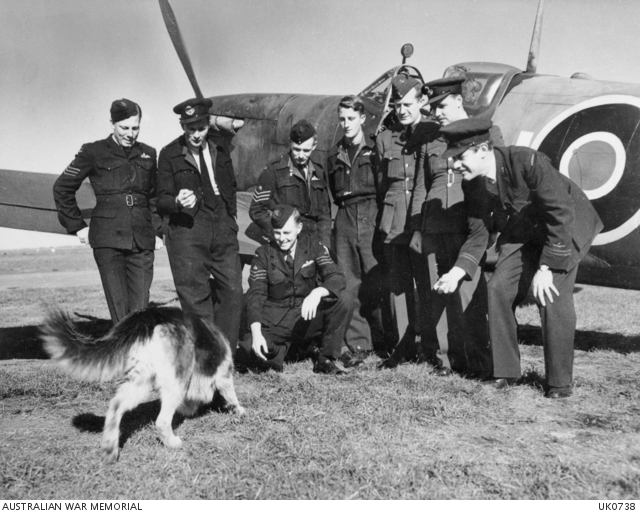
Members of No. 453 Squadron with their mascot, Sprog, at Perranporth on 14 October 1943. The Australian War Memorial identifies the scene as a farewell before the unit moved to the Orkneys. [15]
The group includes Clarence Alfred Seeney, engineer officer R. Bush, pilots K. C. Kinross, H. F. Watts and R. Lyall, together with radio, intelligence and medical personnel. It is a reminder of the range of work contained within a flying squadron. [15]
1944 | FLEET AIR ARM
Swordfish and Avengers
In April 1944 Perranporth’s role changed. Naval aircraft replaced the station’s familiar concentration of Spitfires: No. 816 Naval Air Squadron flew Swordfish, while Nos. 849 and 850 flew Avengers. [4, 5]
Historic England associates the naval squadrons with attacks on German E-boats and shipping around the D-Day period. The Swordfish were equipped to fire rockets; the Avengers were torpedo bombers. [1]
This extends the airfield’s story beyond fighter defence. The safe movement of ships mattered to the wider campaign, and naval aviation formed part of that effort.
Published movement lists place the naval arrivals between 20 and 23 April. Their recorded departure dates extend into August, although other accounts differ on the final dates for individual units. The directory therefore uses April-August 1944 rather than implying that every day has been resolved. [4, 5]
Perranporth contributed to the period surrounding the Normandy invasion; a detailed sortie history would require each naval squadron’s operational records.
1944-1947 | MILITARY RUNDOWN
The end came in stages
Historic England records care and maintenance from 1 September 1944, interrupted by reuse from 23 November until 1 May 1945 for RAF units awaiting transfer to former enemy airfields. [1]
The 2002 archaeological survey places decommissioning later in 1945 and states that most buildings, including hangars, had been dismantled by the end of 1946. It also records late-war alterations, including a new operations room and control building by the end of 1943 and a bomb store in the underground mine workings in 1944. [2]
These sources describe different stages of use and physical change. Air of Authority, in contrast, carries an administrative Transport Command period to April 1947. That does not by itself prove continuous operational flying throughout that period. [5]
For a visitor history, the most defensible wording is that the wartime operational role ended in 1945, followed by rundown and dismantling. A single unqualified “closure date” would conceal the differences in the records.
THE SURVIVING LANDSCAPE
Reading the wartime station
The scheduled monument protects eight separate areas containing fighter pens, shelters and defensive works. It does not designate the entire modern airfield as a single protected block. [1]
| Feature | What it helps explain |
|---|---|
| Fighter pens | Aircraft were separated and shielded from blast. |
| Crew shelters | Protection was provided close to working aircraft. |
| Perimeter track | Dispersals connected with the runways. |
| Battle headquarters | A protected position coordinated ground defence. |
| Pillboxes and gun positions | Defence extended beyond the aircraft themselves. |
Arrange access with the airfield before visiting. The control tower is part of the wider wartime landscape but is not included in this particular scheduling. [1]
1950-2007 | CIVILIAN FLYING
Airlines, gliders and clubs
The UK Airfield Guide records a brief period of commercial services in 1950-51, associating Murray Chown Aviation with a Staverton-Perranporth-Guernsey route and Fingland with Manchester-Perranporth. Perranporth served as the “Newquay” destination in these accounts. [6]
From 1957 the Cornish Gliding Club gave the site another aviation chapter. The cliff setting offered opportunities for soaring, and gliding became an important part of the airfield’s civilian identity. [6, 7]
A 2010 General Aviation profile records recollections from Ernie Hayman and Noel Ellis, instructors during the club’s busy years. It describes a later revival under pilots Brian Sperring and Peter Channon, with Mike and Tina Lomax providing instruction. [7]
Tony Arthur and Richard Seth-Smith, with their wives, subsequently bought the airfield and rebuilt its licensed flying-school activity. By the time of the 2007 sale, retaining a working general aviation airfield was an explicit priority in their account. [7]
The post-war history is therefore a sequence of changes in ownership and activity, rather than a single uninterrupted business.
2007 | A NEW CHAPTER
John George and the airfield
The General Aviation profile identifies John George, founder of JAG Communications, as the buyer of Perranporth in 2007. Companies House records his appointment as a director of Perranporth Airfield Limited on 31 August that year. [7, 8]
A director’s appointment is an independently recorded milestone, although it is not itself a land-transfer document. The purchase year is supported separately by the contemporary aviation profile.
The modern estate is described by management as approximately 400 acres. Earlier sources use smaller figures for the wartime or civilian site. These may concern different boundaries and should not be treated as interchangeable measurements. [2, 7, 10]
The acquisition begins a modern chapter in which aviation sits alongside a wider range of activities and visitors.
2007-2026 | MODERN LIFE
An airfield people can enjoy
The modern airfield story supplied by management includes light aviation, microlights, parachuting, driver experiences, camping, food and drink, motorsport and community events. Each gives people a different reason to encounter the former RAF station. [10]
Perranporth Driving Centre offers a private training environment with road features intended to build driving experience. Its website places the centre at Perranporth Airfield and includes links to under-17 driving, skid-car experiences and Spitfire Raceway. [9]
The same account describes Spitfire Radio CIC’s work from the former control tower, linking broadcasting, veterans, education and heritage. It offers another way to keep people’s stories associated with the site. [10]
A living airfield can preserve a connection with history through both its surviving structures and the stories told about them.
WORKING DIRECTORY | FIGHTERS
Named Spitfire units
Published periods below are broad summaries, not a daily movement log. Short detachments and temporary absences can fall within them. [4, 5]
| Unit | Reported Perranporth period |
|---|---|
| 19 RAF | May 1942-Mar 1943 |
| 65 RAF | Mar-May 1943 |
| 66 RAF | Apr-Dec 1941; Sep-Nov 1943 |
| 118 RAF | 1941-early 1942; dates need checking |
| 130 RAF | 1941/1942-Mar 1943; dates differ |
| 132 RAF | May-Jun 1943 |
| 234 RAF | Late 1942-early 1943; end date differs |
| 302 Polish | Jun-Aug 1943 |
| 310 Czechoslovak | Late Dec 1941-May 1942 |
| 317 Polish | Jun-Aug 1943 |
Nationality describes the unit’s identity, not every member’s citizenship. The first three entries in [4] give precise dates; the chronological summaries here avoid implying that unresolved details are settled.
WORKING DIRECTORY | CONTINUED
Fighters and other units
| Unit | Reported period / aircraft |
|---|---|
| 329 Free French | Early 1944; Spitfire |
| 340 Free French | Nov 1943-Apr 1944; Spitfire |
| 341 Free French | Oct 1943-Apr 1944; Spitfire |
| 412 Canadian | Apr-Jun 1943; Spitfire |
| 453 Australian | Aug-Oct 1943; Spitfire |
| 602 RAF | Jan-Apr 1943; Spitfire |
| 610 RAF | Apr-Jun 1943; Spitfire |
| 616 RAF | Sep 1943 detachment; type to verify |
| 183 RAF | Sep-Oct 1943; Typhoon |
| 276 RAF | Rescue detachment; Walrus/Lysander |
| 286 / 639 RAF | Cooperation units; dates need reconciliation |
| 816 / 849 / 850 NAS | Apr-Aug 1944; Swordfish / Avengers |
Sources: [4, 5]. No. 615 also appears as a 1941-42 detachment in [5]; it is not counted here as a verified Spitfire unit. The 17 Spitfire entries across pages 17-18 do not resolve Historic England’s total of 21. [1]
REMEMBRANCE | SELECTED ACCOUNTS
Lives behind the history
Clarence Alfred Seeney - No. 453 Squadron. Seeney appears in the October 1943 photograph on page 10. The Australian War Memorial records his later loss over France on 25 July 1944. That was after the squadron’s Perranporth period, and should not be described as a loss on a sortie from this airfield. [15]
Spitfire EP749 - a qualified connection. The Devon historic environment record associates a 6 December 1942 crash on Dartmoor with No. 19 Squadron and a possible departure from Perranporth. It explicitly notes uncertainty about the location and connection. [17]
These are selected documented accounts, not a complete roll of honour. A definitive memorial list needs cross-checking against squadron operational record books, casualty records and service identities. Names should never be added merely because a unit served here.
REFERENCES | 1 OF 2
Sources and further reading
- [1] Historic England. Scheduled monument 1020556: official history, significance and extent. Open source.
- [2] M. Fletcher and P. Newman. RAF Perranporth, St Agnes, Cornwall: an archaeological survey. English Heritage, AI/44/2002. Open source.
- [3] Perranporth Aerodrome. Archived airfield history, captured 5 September 2012. Source of the Holmes/Avro account. Open source.
- [4] Cornwall Family History Society. Air Force: RAF Perranporth squadron table. Contains inconsistent dates; used cautiously. Open source.
- [5] Air of Authority. RAF Stations - P: unit movements and administrative chronology. Open source.
- [6] Dick Flute, UK Airfield Guide. Perranporth: airline services and gliding chronology. Secondary compilation. Open source.
- [7] Pat Malone, General Aviation. Westward Ho! April 2010, pp. 38-41: interviews and civilian ownership history. Open source.
- [8] Companies House. Perranporth Airfield Limited, 03601291: director appointment record. Open source.
- [9] Perranporth Driving Centre. Official website: present-day training offer and location. Open source.
REFERENCES | 2 OF 2
Sources and further reading
- [10] Andy Whitaker / management history. Information supplied in conversation: modern ownership, management and activities through 2026. No separate archival document inspected.
- [11] Free Czechoslovak Air Force Associates. Frantisek Dolezal - One of the Few, 9 September 2024. Open source.
- [12] Free Czechoslovak Air Force Associates. Frantisek Vindis - One of the Few, 21 August 2025. Open source.
- [13] Air of Authority. No. 145 Airfield/Wing: formation and personnel. Open source.
- [14] Fondation de la France Libre. Paul Borrossi: biography and final patrol account. Open source.
- [15] Australian War Memorial. UK0738: No. 453 Squadron and Sprog, 14 October 1943. Photograph: public domain. Open source.
- [16] Australian War Memorial. UK0689: dispersal maintenance, October 1943. Photograph: public domain. Caption identifies Perranporth despite a conflicting place tag. Open source.
- [17] Devon / Dartmoor historic environment record. MDV107778: EP749 crash; uncertain location and station attribution. Open source.
Further reading: F. R. Andrew, The history of RAF Perranporth 1941-1945, revised edition (2002). This booklet is identified in published heritage research but was not directly inspected for this edition. A full squadron and casualty audit remains necessary before claiming a definitive directory or roll of honour.